
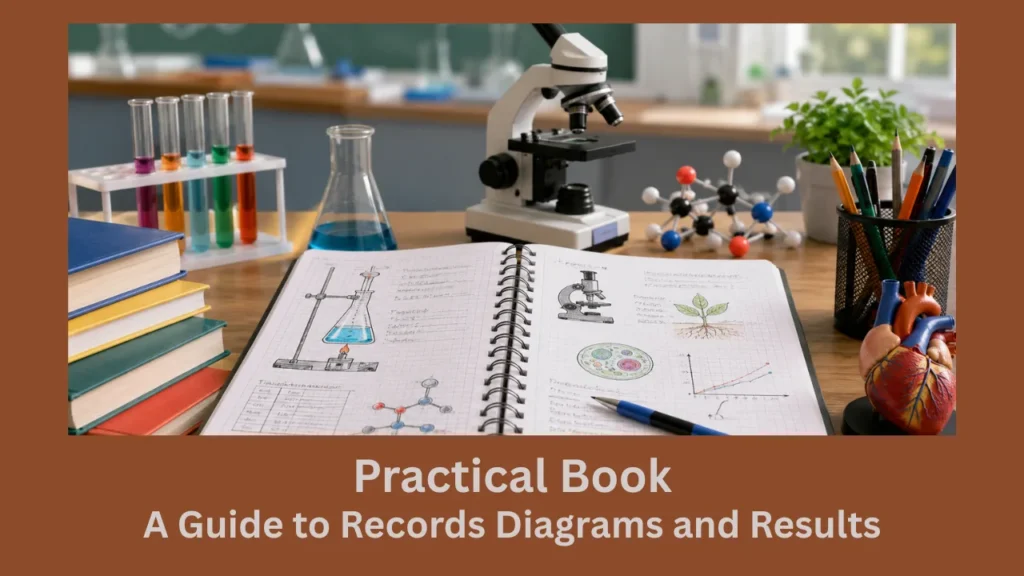
A practical book plays an important role in the Indian education system. It helps students record experiments, activities, observations, projects, and other hands-on work. Students commonly use these books in schools, colleges, technical institutes, and vocational courses. Students searching for study materials such as abo desire novel may also come across practical manuals and educational PDFs online. However, practical learning is different because students must perform activities and record what they observe.
In India, practical work is especially common in Physics, Chemistry, Biology, Computer Science, and vocational subjects. CBSE and NCERT also provide practical and laboratory learning materials for different subjects and classes.
What Is a Practical Book?
A practical book is a notebook, record file, or educational manual related to hands-on academic activities. Students may use it to write experiments, observations, calculations, diagrams, results, and precautions. In many Indian schools, teachers ask students to maintain a practical record throughout the academic year. Teachers may check the record and use practical work as part of internal or practical assessment.
The exact format depends on the school board, class, course, and subject. Science students usually record experiments, while computer students may record programs and their outputs.
Practical Books in the Indian Education System
| Practical Feature | Purpose |
|---|---|
| Aim | Explains the purpose of the activity |
| Materials | Lists required equipment |
| Theory | Explains the basic concept |
| Procedure | Gives the steps of the experiment |
| Observation | Records what the student notices |
| Calculation | Shows numerical work when required |
| Diagram | Presents the setup visually |
| Result | States the final finding |
| Precautions | Helps avoid errors and unsafe practices |
Why Practical Work Is Important for Students
A practical book helps connect classroom lessons with real activities. Students understand many concepts better when they perform an experiment instead of only reading its theory. For example, a student can read about electric circuits in a Physics textbook. However, connecting a circuit and observing its behavior can make the concept much easier to understand.
Practical activities can also improve observation, problem-solving, measurement, and analytical skills. These abilities are useful for examinations as well as higher education. Practical learning encourages students to understand a process instead of simply memorizing an answer. It can also make science and technical subjects more interesting.
Main Sections of a Practical Record
| Section | Information Included |
|---|---|
| Experiment Number | Serial number of the activity |
| Date | Date when work was performed |
| Title | Name of the experiment |
| Aim | What the experiment tests |
| Apparatus | Equipment and materials required |
| Theory | Scientific idea behind the activity |
| Procedure | Steps followed by the student |
| Observation | Data collected during the activity |
| Result | Final finding |
| Precautions | Steps taken to reduce errors |
Subjects That Commonly Require Practical Records
| Subject | Common Practical Work |
|---|---|
| Physics | Measurements, circuits and optics |
| Chemistry | Reactions, titration and analysis |
| Biology | Slides, specimens and experiments |
| Computer Science | Coding, databases and outputs |
| Mathematics | Activities and mathematical models |
| Geography | Maps, surveys and data |
| Vocational Subjects | Skill-based activities and projects |
Practical Book and Practical Manual Difference
Students sometimes use the terms practical record and practical manual for the same material. However, they can serve different purposes. A practical manual generally gives instructions for completing an experiment or activity. It may provide the aim, required apparatus, method, diagrams, questions, and safety guidance.
A record book is mainly where the student writes the work completed during practical sessions. It can contain observations, readings, calculations, results, diagrams, and teacher remarks. A manual teaches students what to do, while a record shows what they actually completed.
Role of CBSE and NCERT Practical Materials
CBSE provides curriculum documents and practical guidance for subjects that contain laboratory or skill-based components. Requirements can differ according to the subject and academic session. NCERT provides laboratory manuals for subjects including Science, Mathematics, Physics, Chemistry, and Biology. These resources support activity-based learning and help students understand experiments.
Students should use the latest official syllabus when preparing practical work. Requirements can change between academic sessions, classes, subjects, and education boards. State boards may also publish their own instructions and textbooks. Therefore, a CBSE format may not always match the requirements of another education board.
How to Write a Good Practical Record
A practical book should be clean, clear, and properly organized. Students should record experiments in the sequence recommended by their teachers. Start each experiment with its number, date, title, and aim. Write the theory in simple language and describe the procedure in the correct order.
Students should enter observations carefully because incorrect readings can affect calculations and results. Units such as centimetres, grams, volts, or seconds should also be written correctly. Diagrams should be neat and properly labelled. Students should avoid unnecessary decoration because the main purpose is to present academic work clearly.
Importance of Diagrams and Observation Tables
Diagrams make practical work easier to understand. A clear diagram can show equipment, connections, specimens, or experimental arrangements that are difficult to explain using text alone. Observation tables organize measurements and findings. They also make calculations easier because students can compare values in a structured format.
For example, Physics experiments may require several readings of voltage, current, distance, or time. Recording these readings in a table reduces confusion and makes the final calculation clearer. Always use the units and labels required for the experiment. This small step improves the quality and accuracy of the record.
Practical Assessment and Examinations
Practical work can contribute to assessment in many Indian courses. The marks and assessment structure depend on the board, class, subject, and current syllabus. Students may be assessed on experiments, projects, activities, records, and viva questions. A viva is a short oral examination in which an examiner asks questions about the practical work.
Students should understand every experiment they record. Simply copying an experiment without understanding its purpose may make answering viva questions difficult. Teachers may also check whether the student maintained the record regularly. Completing practical work on time can make revision easier before the final assessment.
Practical Learning Versus Theory Learning
| Theory Learning | Practical Learning |
|---|---|
| Focuses on concepts | Focuses on application |
| Mainly uses textbooks | Uses equipment and activities |
| Develops conceptual knowledge | Develops hands-on skills |
| Often uses written questions | Uses experiments and observations |
| Explains how things work | Demonstrates how things work |
Common Mistakes Students Should Avoid
Students sometimes complete their practical book just before submission. This approach can lead to missing experiments, incorrect observations, and poorly prepared diagrams. Students should record activities soon after performing them. This makes it easier to remember the correct procedure, readings, and conclusions.
Another common mistake is copying another student’s observations without checking the actual experiment. Practical readings may differ because of equipment, conditions, and measurement errors. Students should also avoid writing results that do not match their recorded observations. Teachers usually value clear and logical work more than decorative presentation.
Can Students Get Practical Materials Online?
Many educational materials are now available online. CBSE, NCERT, universities, schools, and educational platforms may provide laboratory manuals, syllabi, sample activities, and instructions. Students should prefer official and reliable educational sources when downloading academic materials. An old PDF may follow a syllabus that no longer applies to the current academic session.
Online resources can help students understand procedures and prepare for viva questions. However, they should not replace experiments that the school or college requires students to perform.
How Practical Records Help With Revision
A completed record becomes a useful revision resource before examinations. Students can review aims, formulas, diagrams, observations, procedures, and results without reading the entire textbook. The record can also help students prepare for oral questions. Revising the reason behind each step makes it easier to explain the experiment confidently.
Regular preparation is better than completing all activities near the examination date. It gives students more time to understand difficult concepts and correct mistakes.
Conclusion
A practical book is an important part of hands-on education in India. It helps students organize experiments, activities, observations, diagrams, calculations, and results in one place. Practical learning can improve understanding, observation, problem-solving, and technical skills. Students should follow their teacher’s instructions and the latest syllabus when preparing their records.
A neat record is useful for assessment, revision, and viva preparation. More importantly, practical activities help students see how ideas learned in the classroom work in real situations.