India has a rich tradition of spiritual books that teach devotion, courage, wisdom, and the victory of good over evil. Readers may explore many kinds of literature, including abo desire novel, but sacred texts hold a different place in Indian culture. The durga saptashati book is an important Hindu religious text dedicated to Goddess Durga and the power of Devi. It tells sacred stories about the Goddess, her different forms, and her battles against powerful demons.
The scripture is widely read during Navratri and is closely linked with Shakti worship in India. Its stories also explore courage, devotion, knowledge, protection, and freedom from ignorance.
What Is the Durga Saptashati Book?
The durga saptashati book is a sacred Sanskrit text that contains 700 verses divided into 13 chapters. It forms part of the ancient Markandeya Purana and is one of the best-known texts devoted to Goddess Durga. The scripture is also called Devi Mahatmya and is closely associated with Chandi Path. The word “Saptashati” refers to seven hundred, which reflects the traditional count of verses in the text.
| Main Detail | Information |
|---|---|
| Primary Name | Durga Saptashati |
| Other Name | Devi Mahatmya |
| Associated Recitation | Chandi Path |
| Original Language | Sanskrit |
| Total Verses | 700 |
| Total Chapters | 13 |
| Part of | Markandeya Purana |
| Main Deity | Goddess Durga |
| Major Festival | Navratri |
Origin and History of Durga Saptashati
Durga Saptashati appears within the Markandeya Purana, one of the Puranic texts of Hindu tradition. The Devi Mahatmya is traditionally identified with chapters 81 through 93 of that larger work. The scripture became highly influential within the Shakta tradition, which places the Divine Feminine at the center of worship. Devi appears as a supreme power rather than simply a supporting character in the stories.
Why Is It Called Durga Saptashati?
| Traditional Section | Chapters | Main Focus |
|---|---|---|
| Prathama Charita | 1 | Madhu and Kaitabha |
| Madhyama Charita | 2–4 | Mahishasura |
| Uttama Charita | 5–13 | Shumbha, Nishumbha and other demons |
Story of King Suratha and Samadhi
The larger narrative begins with King Suratha and a merchant often called Samadhi. Both experience loss and remain emotionally attached to things that have caused them suffering. They approach Sage Medhas and ask him about the nature of this attachment. The sage responds by explaining the power of Mahamaya through stories about the Goddess.
This framework gives the scripture a deeper purpose. The battles are not presented only as physical conflicts, as they also help explain spiritual questions about attachment and divine power. The final chapter returns to Suratha and the merchant. They worship the Goddess, and Devi eventually grants them blessings according to their different desires.
The Story of Madhu and Kaitabha
The first Charita introduces the divine power of Mahamaya and the story involving the demons Madhu and Kaitabha. It establishes the Goddess as a cosmic power with influence over the forces of the universe. This opening prepares readers for the later stories. It shows that Devi’s power is not limited to one battle, place, or physical form.
The section also introduces ideas about illusion, awareness, and divine intervention. These themes continue throughout the remaining chapters.
Goddess Durga and Mahishasura
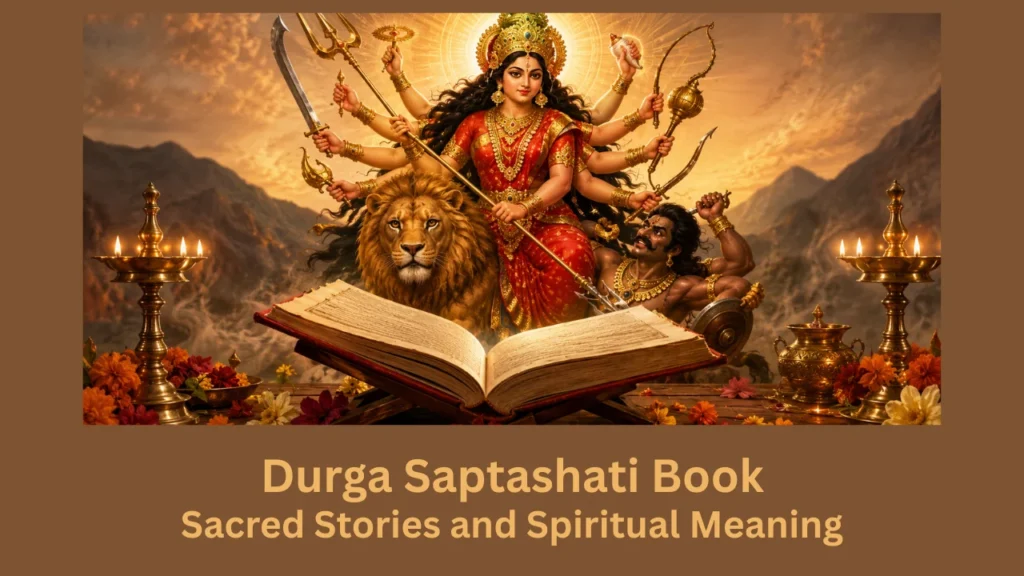
One of the most famous sections describes the conflict between the Goddess and Mahishasura. His growing power creates a serious threat, leading to the manifestation of a mighty Goddess. The gods give their divine powers and weapons to her for battle. She fights Mahishasura and his forces before defeating him.
This story created one of the most recognizable forms of Durga in Indian religious art. Mahishasura Mardini represents Durga as the destroyer of Mahishasura and a defender of divine order. The durga saptashati book therefore presents courage through a powerful sacred narrative. Devotees view the victory as a reminder of the triumph of divine power over destructive forces.
Shumbha, Nishumbha and Raktabija
Later chapters describe another major series of battles involving Shumbha and Nishumbha. These sections also introduce other powerful opponents and manifestations of the Goddess. One famous figure is Raktabija. His unusual power makes the battle difficult because drops of his blood can produce more forms of him when they reach the ground.
The Goddess eventually overcomes this challenge through her divine manifestations. These dramatic stories highlight intelligence and power working together against difficult obstacles. The battles also show several forms of Devi acting toward one purpose. This reinforces the idea of one divine feminine power appearing through different manifestations.
Three Major Forms of Divine Power
| Divine Form | Common Association |
|---|---|
| Mahakali | Transformative power and destruction of evil |
| Mahalakshmi | Divine strength, prosperity and protection |
| Mahasaraswati | Wisdom, knowledge and spiritual awareness |
Importance of Durga Saptashati During Navratri
Navratri is one of the main periods when devotees read the durga saptashati book in India. The nine-night festival celebrates different forms and aspects of the Divine Mother. Many devotees perform a complete or scheduled recitation during this period. Ritual reading of the sacred text is widely known as Chandi Path.
Some families read the scripture at home, while temples may organize collective recitations and religious ceremonies. Practices can differ according to region, family tradition, and spiritual teacher. Navratri gives devotees time to focus on discipline, prayer, worship, and reflection. Durga Saptashati becomes an important part of this devotional environment for many worshippers.
What Is Chandi Path?
Chandi is another name connected with the powerful form of the Goddess. Chandi Path commonly refers to the ritual recitation of Devi Mahatmya or Durga Saptashati. A traditional recitation can involve more than simply opening the scripture and reading its chapters. Some traditions follow particular prayers, preparation steps, and additional hymns.
Indian editions may therefore contain supporting material before and after the core 700 verses. The exact method can differ between traditions.
Devi Kavach, Argala and Keelak
Many editions of the durga saptashati book contain additional texts associated with its traditional recitation. Three names that readers frequently encounter are Devi Kavach, Argala Stotram, and Keelak Stotram. The Devi Kavach is traditionally understood as a protective hymn. Argala and Keelak also hold specific places within established recitation traditions.
Spiritual Meaning Behind the Battles
The stories can be read as sacred narratives, but many readers also understand them symbolically. The demons can represent harmful forces, ignorance, uncontrolled desire, pride, or other inner struggles. Durga’s victories can then represent courage, knowledge, discipline, and the movement from confusion toward awareness. This interpretation gives the ancient battles personal meaning for modern readers.
Durga Saptashati and Shakti Worship
Shakti means divine power or energy and holds a central position in many Hindu traditions. Shakta traditions particularly emphasize the Goddess as the supreme divine reality. The durga saptashati book became an influential scripture for this understanding of the Divine Feminine. It presents the Goddess through many forms while connecting those forms to a greater divine power.
Durga can appear fierce when she fights destructive forces and compassionate toward devotees who seek her blessings. This balance between strength and compassion gives the text much of its religious depth.
Durga Saptashati Books Available in India
| Type of Edition | Best Suited For |
|---|---|
| Sanskrit edition | Readers comfortable with Sanskrit |
| Sanskrit-Hindi edition | Hindi readers seeking meaning |
| Translated edition | Beginners studying the stories |
| Commentary edition | Readers seeking deeper explanations |
| Ritual edition | Devotees learning traditional recitation |
Conclusion
The durga saptashati book is a major Hindu sacred text devoted to Goddess Durga and the greatness of the Divine Feminine. Its 700 verses and 13 chapters tell powerful stories involving Mahishasura, Shumbha, Nishumbha, Raktabija, and other figures.
The scripture is also known as Devi Mahatmya, while its ritual recitation is widely associated with Chandi Path. It remains especially significant during Navratri and within traditions centered on Shakti.