
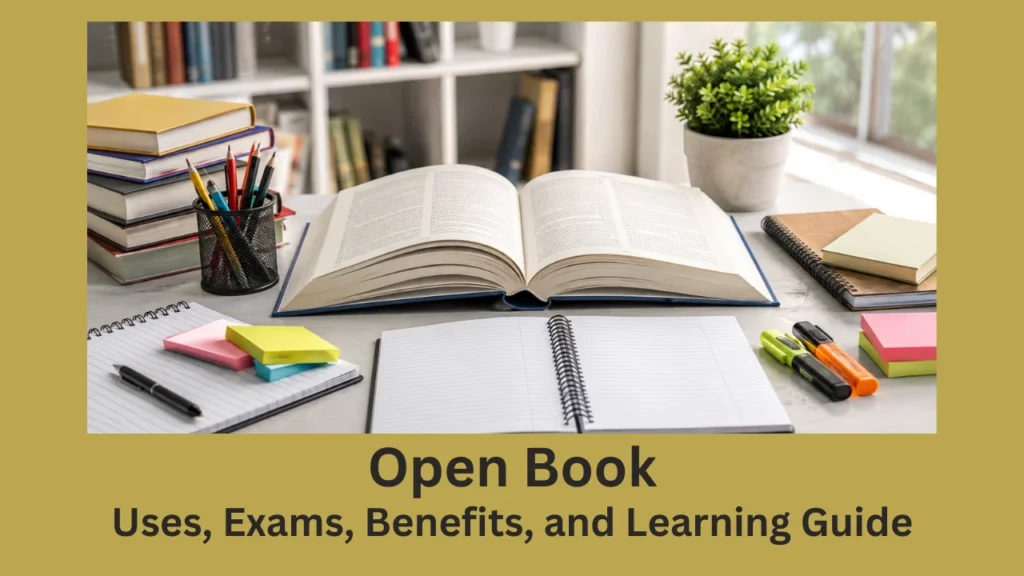
Students use many types of books and learning tools during their education. A graph book helps with charts and math, while an open book approach helps students find and apply information during certain exams.
The term has meanings in education and everyday English. It commonly describes an exam that allows approved study materials or a person who is easy to understand.
What Does Open Book Mean?
An open book exam allows students to use certain approved materials while answering questions. These may include textbooks, notes, reference sheets, or other resources allowed by the teacher. However, students cannot always use every resource they want. Each school, teacher, or testing body sets its own rules about which materials are permitted.
The phrase also works as an English idiom. When someone calls a person “an open book,” they mean that the person’s thoughts and feelings are easy to understand.
Understanding the Open-Book Exam
An open-book exam tests how well students understand and use information. Teachers often design questions that require reasoning instead of asking students to recall simple facts. Students may need to compare ideas, solve problems, explain a case, or support an answer with evidence. Having a textbook nearby does not remove the need to understand the subject.
These exams appear in schools, colleges, universities, and some professional courses. The exact format can change according to the subject and the goals of the assessment.
How Does an Open-Book Exam Work?
| Exam Feature | Common Practice |
|---|---|
| Textbooks | Often allowed |
| Personal notes | May be allowed |
| Formula sheets | Often allowed in technical subjects |
| Internet access | Depends on exam rules |
| Communication with others | Usually prohibited |
| Time limit | Usually applies |
| AI tools | Only when clearly permitted |
Open-Book Exam vs Closed-Book Exam
A closed-book exam usually requires students to answer questions without checking textbooks or personal notes. This format often places greater importance on memory and recall.
| Feature | Open-Book Exam | Closed-Book Exam |
|---|---|---|
| Textbook access | Usually permitted | Usually not permitted |
| Notes | Sometimes permitted | Usually not permitted |
| Main skill | Applying knowledge | Recall and understanding |
| Question style | Often analytical | Can include recall questions |
| Preparation | Understanding and organization | Understanding and memorization |
| Resource searching | Possible | Very limited |
Why Schools Use Open-Book Exams
Education involves more than remembering facts. In daily life, people often have access to books, manuals, databases, and other sources when solving problems. Open-book tests can reflect this situation by asking learners to find useful information and apply it correctly. Students must understand which facts matter and how they connect to the question.
This assessment style can encourage deeper learning when teachers design the questions carefully. It can also show whether students understand ideas rather than simply memorizing definitions.
Are Open-Book Exams Easy?
Many students assume these exams are easy because they can look at their notes. This belief can cause problems because searching for every answer takes time. A well-designed open book exam may contain questions that cannot be answered by copying one sentence from a textbook. Students must understand the topic before they can use their resources effectively.
Time limits also make preparation important. A student who knows where to find key information can work much faster than someone searching through an entire book.
How to Prepare for an Open-Book Exam
Start by learning the subject as you would for a normal test. Read the main chapters, understand important concepts, and practice answering questions before exam day. Next, organize the materials that the exam rules allow. Add clear headings or tabs to important sections so you can locate information quickly.
You can also create a short index of key topics and their locations. Good organization saves valuable exam time and reduces unnecessary searching. Practice is equally important. Try sample questions while using the same resources that you plan to use during the actual exam.
Effective Note Organization
Good notes should help you find ideas quickly. They should not become a large collection of information that takes several minutes to search. Use clear headings for each topic and keep related concepts together. Highlight only key definitions, formulas, dates, examples, or rules rather than marking every line.
| Organization Method | Main Benefit |
|---|---|
| Chapter tabs | Finds sections quickly |
| Topic headings | Keeps information organized |
| Short summaries | Helps with fast revision |
| Formula sheet | Provides quick calculations |
| Page references | Locates detailed information |
| Practice questions | Builds exam confidence |
A simple system usually works better than complicated notes. Students should be able to locate important information within seconds.
Common Mistakes Students Make
One common mistake is studying less because books will be available during the test. This strategy can leave students unable to understand difficult questions. Another mistake is bringing too many materials. A huge pile of books and notes can slow a student down rather than provide useful support.
Students may also copy information without connecting it to the question. A strong answer explains, analyzes, or applies information instead of simply repeating it. Ignoring exam rules can cause serious problems. Students should know exactly what materials and tools their teacher allows before the assessment begins.
Skills Tested in This Type of Exam
These assessments can test several academic skills at the same time. Students may need to understand a problem, locate evidence, compare sources, and create a clear answer. Critical thinking becomes especially important when a question has more than one possible approach. Students must decide which information provides the strongest support.
Problem-solving also matters in subjects such as science, business, engineering, and mathematics. A formula may be available, but the learner still needs to know when and how to use it.
Benefits for Students
An open book test can reduce the need to memorize large amounts of isolated information. Instead, learners can spend more time understanding relationships between ideas. This format can also encourage students to build useful research and reference skills. Knowing how to find reliable information is valuable in both education and professional life.
However, the format still requires preparation. The greatest benefit comes when students combine strong subject knowledge with well-organized resources.
Meaning as an English Idiom
The phrase has another popular meaning outside education. Calling someone an open book means that the person’s thoughts, feelings, or intentions are easy for others to understand. For example, someone may say, “My brother is easy to understand because he is an open book.” The expression suggests openness rather than an actual book.
A related phrase is “read someone like a book.” It means you can understand someone’s feelings or intentions from their words, expressions, or behavior.
Open-Book Learning in the Digital Age
Digital learning has changed how students access information. Many learners now use electronic textbooks, learning platforms, online libraries, and digital notes. As a result, some exams take place online and may permit selected digital materials. Students must still follow the exact rules because online access does not mean every tool is allowed.
Schools can use digital assessments to test research, judgment, and problem-solving skills. Clear rules remain essential for keeping the assessment fair.
Why Understanding Matters More Than Searching
Books can provide definitions, examples, and facts, but they cannot automatically create a good answer. The student must decide how the available information relates to the problem. This is why understanding remains important in an open book assessment. Students who know the subject can find information faster and explain it more clearly.
The best preparation combines knowledge, practice, organization, and time management. These skills can also help students beyond exams.
Conclusion
Open-book learning shows that education does not always depend on memorizing every fact. It can measure how well students understand information, locate useful details, and apply knowledge to new situations.
At the same time, students should never assume that access to materials makes an exam simple. Preparation, critical thinking, clear writing, and good time management remain essential for strong performance.