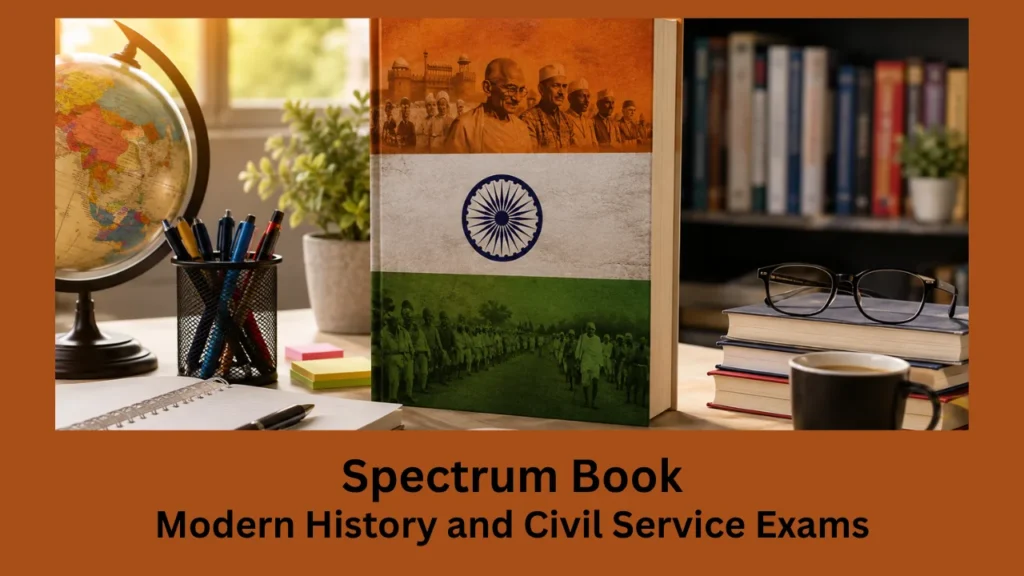
Students in India use many study resources, from history textbooks to fiction such as abo desire novel. However, competitive exam aspirants need books that present facts in a clear and organized way. The spectrum book has become a familiar name among students preparing for civil services and other government exams. In most UPSC discussions, this name refers to A Brief History of Modern India by Rajiv Ahir. Spectrum Books publishes the title and has released several revised editions over the years.
What Is Spectrum Book?
The spectrum book is a popular modern Indian history resource used by many competitive exam aspirants. Its full title is A Brief History of Modern India, and Rajiv Ahir is its main author.
The book explains important events that shaped India during the modern period. It covers European expansion, British rule, social reforms, resistance movements, and India’s freedom struggle.
| Book Detail | Information |
|---|---|
| Full Name | A Brief History of Modern India |
| Author | Rajiv Ahir |
| Publisher | Spectrum Books Pvt. Ltd. |
| Main Subject | Modern Indian History |
| Popular Among | UPSC and State PCS aspirants |
| Format | Paperback |
| Hindi Edition | Available |
| First Published | 1995 |
History and Background of the Book
Spectrum Books first published this title in 1995, and the publisher continued to revise it afterward. The repeated revisions allowed editors to reorganize material and add information useful to modern history students. For example, Google Books lists the 2019 edition as the 25th edition, with Rajiv Ahir as author. This shows how established the title had already become among readers by that time.
The purpose of the book is not simply to provide dates and names. It connects political events with social, economic, educational, and administrative changes in India.
What Does Spectrum Modern History Cover?
| Major Topic | What Students Learn |
|---|---|
| European Arrival | Portuguese, Dutch, English and other European powers |
| British Expansion | Growth and consolidation of British power |
| Revolt of 1857 | Causes, events, leaders and consequences |
| Social Reform | Important social and religious reform movements |
| Freedom Struggle | Growth and phases of Indian nationalism |
| British Economy | Economic effects of colonial policies |
| Education | Development of education under British rule |
| Indian Press | Growth and role of newspapers and journalism |
| Peasant Movements | Major rural protests and movements |
| Tribal Movements | Resistance among tribal communities |
| Working Class | Development of workers’ movements |
| Independence | Events leading toward freedom and partition |
Advent of Europeans and British Expansion
One major section explains how different European powers reached India. Students learn about the Portuguese, Dutch and English and their growing commercial interests. The book then describes how the East India Company changed from a trading organization into a political power. Major conflicts and developments involving Bengal, Mysore, the Marathas, Sindh and Punjab also receive attention.
This chronological approach helps readers understand why British control did not appear overnight. Political decisions, wars, alliances and economic power gradually changed India’s political structure.
The Revolt of 1857
The Revolt of 1857 remains an important subject in modern Indian history. Students preparing for competitive exams need to understand its causes, important figures, regions and results. The book places the revolt within the wider story of resistance against colonial authority. This approach helps readers connect the uprising with political and social conditions of the period.
Understanding these links can be more useful than simply memorizing dates. Students can see how different events influenced later developments in Indian nationalism.
Social and Religious Reform Movements
The spectrum book also gives attention to social and religious reform movements. These movements influenced education, social customs, religious thinking and public debate. Students encounter reformers and organizations connected with major changes in Indian society. The subject is important because social reform developed alongside political change during colonial rule.
Indian National Movement and Freedom Struggle
| Phase | Main Area of Study |
|---|---|
| Early Nationalism | Beginning of organized political activity |
| Swadeshi Period | Protest and national political growth |
| Mass Nationalism | Wider public participation |
| Non-Cooperation | Large-scale movement against British authority |
| Civil Disobedience | Organized resistance to colonial policies |
| Quit India | Major movement during the Second World War |
| 1940s | Final phase before independence |
| 1947 | Independence and partition |
Economic Impact of British Rule
Modern history is not limited to wars and political leaders. Colonial economic policies changed agriculture, industries, trade, taxation and the lives of ordinary people. The book provides dedicated coverage of the economic impact of British rule. This helps students understand the relationship between colonial administration and India’s economic conditions.
Economic topics also help explain why dissatisfaction with British rule increased. Political nationalism developed within a wider environment of economic and social change.
Development of Education and the Press
Education became an important part of social change during British rule. The title covers policies and developments connected with colonial education. Topics found in editions of the book include the Charter Act of 1813, Macaulay’s Minute and Wood’s Despatch. Later developments and education commissions also appear in its coverage.
Why Is Spectrum Book Popular for UPSC?
The spectrum book is closely associated with UPSC preparation because its subject matches important areas of the examination. Modern Indian history and the national movement form part of the broader history preparation required by aspirants.
Its organized structure also makes revision easier than working through several unrelated sources. Students can move through events in chronological order and return to specific topics when revising. The book is also used by aspirants preparing for various State PCS examinations. However, candidates should always compare their books with the latest official syllabus for their examination.
Spectrum Book for Prelims Preparation
UPSC Prelims requires students to recognize facts, events, people and relationships between historical developments. A well-organized history source can make this process easier. Students can first read a chapter to understand the story behind the events. During later readings, they can focus on dates, organizations, personalities, laws and important developments.
Spectrum Book for UPSC Mains
Mains preparation requires more than memorizing isolated facts. Students need to explain causes, effects and links between major developments. The spectrum book can provide factual material that students can use to build their understanding. Topics such as nationalism, colonial economic policies and reform movements can support structured history answers.
How to Study the Book Effectively
| Study Stage | Recommended Approach |
|---|---|
| First Reading | Understand the historical story |
| Second Reading | Identify important facts and events |
| Third Reading | Focus on weak and high-value areas |
| Notes | Record short facts and timelines |
| Revision | Review chapters regularly |
| Practice | Solve previous-year questions |
Important Chapters for Students
The freedom struggle, Revolt of 1857, British expansion and reform movements deserve close attention. Economic policies, education, the press and popular resistance are also valuable areas. The exact priority can change depending on the exam and syllabus. Therefore, candidates should use the official syllabus and previous questions to decide where to spend more time.
Spectrum and NCERT Books
Students often use Spectrum with NCERT history books rather than treating the two sources as direct replacements. NCERT material can help create a basic understanding before a detailed competitive exam book. After building that foundation, Spectrum can provide a more organized review of modern history topics. This combination can help beginners avoid feeling overwhelmed by names, movements and dates.
Students should still limit their sources when possible. Repeated revision of reliable material often works better than collecting many books without finishing them.
Advantages and Limitations
One major advantage is the book’s wide coverage of modern Indian history. It combines political, economic and social developments within one structured resource. However, its amount of information can feel heavy for complete beginners. New students may benefit from learning the basic timeline before attempting detailed revision.
No single reference book should replace the official exam syllabus or previous-year questions. Aspirants should use books as study tools rather than treating every line as equally important.
Conclusion
The spectrum book has developed a strong place in India’s competitive exam study culture. A Brief History of Modern India brings major events of modern history together in a systematic format.
Its coverage ranges from European expansion and British rule to reform movements, nationalism and independence. Students can gain the most value by combining careful reading with notes, revision and previous-year question practice.